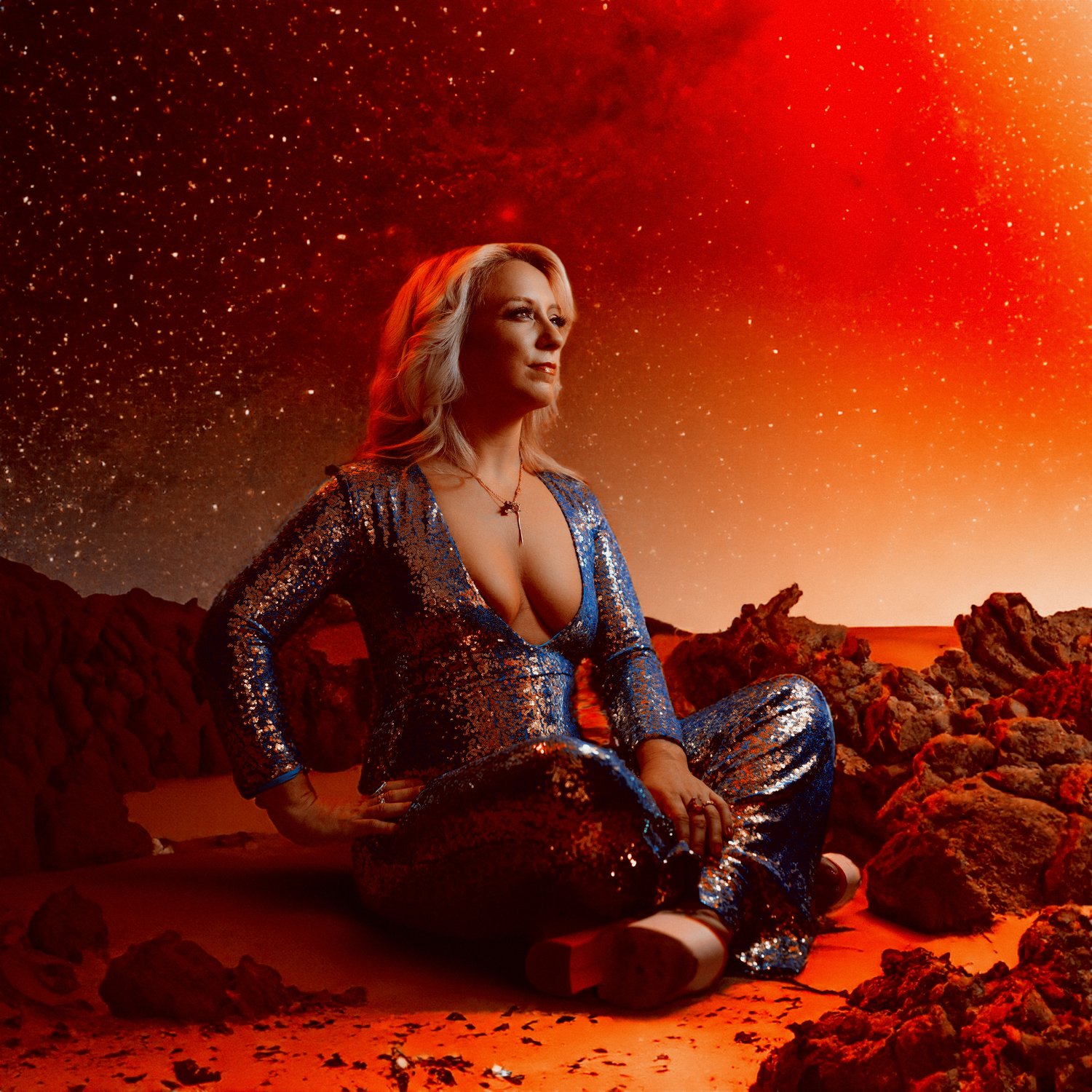
iNTRODUCING Harriet
A live performance of Harriet Stubbs’s brand new album 💿 Living On Mars, produced by Mike Garson of Bowie’s Aladdin Sane. Featuring repertoire from Bach to Nick Cave & The Bad Seeds.
.
.
.
Paul Cavalconte of WNYC and WQXR’s Introduction
3:15. Space Oddity [Bowie]
07:30. Pathetique Variations [Beethoven]
11:46. “I am” [Garson]
12:37. Push The Sky Away [Nick Cave & The Bad Seeds]
16:40. Bach/Gould Homage [Garson]
18:40. Blackbird [Beatles]
21:39. Yellow [Coldplay]
26:02. Life On Mars [Bowie]
ENCORE
31:10 Piano Concerto Opus 16 in A Minor [Grieg arr. Percy Grainger]
There is always a story to be told. Classical pianist Harriet Stubbs delivered hers as a triptych, beginning with her 2018 debut album Heaven And Hell: The Doors Of Perception (Naxos Of America). Produced by Grammy-winning producer Russ Titelman (Eric Clapton, George Harrison, Paul Simon) and featuring Marianne Faithfull, Heaven and Hell, based on William Blake’s concept of the doors of perception and how humans see reality through the lens of ego, social conditioning, and other outside forces, was the first chapter of Harriet’s triad.
In 2023, the story and a search for enlightenment unfolded with her second release, Living On Mars (The Orchard), penetrating and shifting the perception of life and art through space and time. Produced by David Bowie’s longtime collaborator and keyboardist Mike Garson, Living on Mars features a repertoire of homages to Bach, Chopin, and Godowsky, to Harriet’s interpretation of the Beatles’ “Blackbird,” Coldplay’s “Yellow,” and Nick Cave & The Bad Seeds’ “Push the Sky Away,” all bookended by Bowie’s “Space Oddity” and “Life on Mars.”
The Cost of Enlightenment (Fall 2026) is the third album and the final piece of her concerto of self and social realizations, and the materializations of something more authentic.
Returning to work with producer Garson, The Cost of Enlightenment was built around the idea of “striving for something greater than us at a time when the world feels turned upside down, and continuing, regardless, to turn it back around,” says Harriet.
And what is the cost of enlightenment? It’s a question Harriet responds to with her spellbinding and contemporary takes on Beethoven’s sonatas, from No. 28 in A major, Op. 101 through No. 31 in B major, Op. 110. Before he died in 1827, Beethoven composed 32 sonatas between 1795 and 1822, in Vienna during the final stages of his hearing loss, leaving behind a collection of more somber movements around grief and the links between life and death.
“Beethoven did for the structure of the sonata what Shakespeare did for the English language in terms of architecture,” says Harriet. “So from that point of view, I see it as an exercise in architecture, and relate it to a reflection of the human condition. It’s almost like ‘Hamlet’ in the sense that it can be read 19 different ways, all of them a response to the human condition.”
Beethoven’s 110 was a piece Harriet marinated over for five years and had particular significance to her own life and grief, and 101 associated more with her 2025 diagnosis and recovery from ulnar nerve compression, which attacked both her hands and nearly put an end to her career.
The costs of enlightenment are explored on more crossover pieces on the album by special guest Scissor Sisters’ Jake Shears, who fills the contemplative, D Minor centerpiece on the album with the more baroque-pop “Payday.” His contribution follows the succession of Bach-Busoni's “Chaconne” on Heaven and Hell and Cave’s “Push the Sky Away” on Living on Mars, all midway points moving the listener to the other side of the journey.
Time is banging on the floorboards / Happy birthday, Mother God / Stick a mirror on my tombstone / Here comes my body, sings Shears, mourning the things and times no longer within reach.
Part of the cost of enlightenment is going against the grain to pursue something of great value, which comes at a huge cost, both at a micro and a macro level, says Harriet.
“I think everyone who is fighting the good fight right now feels that, and I think that's also why it was really important to go completely against the grain and put in late heavy Beethoven. I’m not putting in playlist Beethoven; it’s not lightweight.”
Crafting one’s art is especially challenging in today’s world, especially when creativity is being questioned and exhausted by social media, AI, and the adversity to the arts, academia, sciences, and beyond.
“This is the biggest ‘Fuck you’ to the consumption process that is happening by including important artists in that trajectory,” adds Harriet, "but not taking away from the magnum opuses that are still invaluable reflections on the human condition, which is the whole point of what we're trying to do, and what AI cannot do.”
_____Background
Born in Sussex, England, Harriet Stubbs grew up in London and started playing piano at the age of three before taking her talents public a year later. By five, she was awarded a full scholarship to the Guildhall School of Music and studied under the late Professor Emeritus, Jimmy Gibb (1918-2013), and completed Grade Eight with distinction within two years.
A year later, Harriet was invited to perform at the Blackheath International Piano Festival and went on to give solo recitals throughout the UK, including Brighton Festival, Canterbury Theatre, and Castle Howard, along with performances of Mozart's piano concerto K414 and Bach's D minor with the Primavera Chamber Ensemble at The Rye Festival Winter Series.
In her early teens, Harriet was featured in an interview on the BBC and voted one of the top three pianists in Britain by Julian Lloyd Webber on ITV's Britain's Brilliant Prodigies, before performing in the 2004 film Harry Potter And The Prisoner of Azkaban.
After completing her undergraduate degree at Trinity Laban Conservatoire of Music and Dance in London, studying with Douglas Finch, Stubbs’ solo performances extended to St. John's Smith Square, St. John's Waterloo, Cheltenham Recital Series, The Reform Club, St. James's Piccadilly, The Georgian Theatre Royal, London City Lights Festival, for the Rt. Hon. Lord Mayor of London and Sheriffs for the 800th Anniversary Awards Trust and for the Ambassador of the United States of America.
Earlier in her career, Harriet also began performing throughout Europe—in Italy with Angela Hewitt, in Spain, and in Greece for the Prime Minister on National Television, and also collaborated with Katie Derham on an episode of BBC Maestro, BBC Radio 1 DJ Goldie, and Blur bassist Alex James.
A voting member of the New York Chapter of the Recording Academy and an artist member of the TJ Martell Foundation, Harriet has also had an extensive career in the U.S. and performances spanning everywhere from Carnegie Hall and Tibet House to Lincoln Center, the Stephen Talkhouse, Joe’s Pub, City Winery, Le Poisson Rouge, and The Cutting Room.
Along with receiving her PADI Divemaster certification in May 2019, for years Harriet has worked with research teams across the North Sea and Arctic Ocean through the Atlantic and Pacific Oceans, from the Florida Keys to the Catalina Islands, free-diving with orcas, collecting data on herring migration, and helping rebuild coral reefs in the Cayman Islands.
During the pandemic lockdown, between 2020 and 2021, Harriet performed 250 daily concerts in the Kensington section of London, which earned her the British Empire Medal by Her late Majesty Queen Elizabeth II in 2022 in recognition of her service to the country.
That same year, Harriet was also named Musical America’s Top 30 Professionals in the Arts for their Resilient Warriors Special of 2022 and had a podcast, The Piano With Harriet Stubbs, which documented being an artist living and working during the pandemic and featured special guests, including American philosopher and activist Cornel West.
Harriet will accompany The Cost of Enlightenment with a worldwide tour in 2026 and 2027 and an upcoming memoir in the works, out early 2028.